The following link are compiled by the Universal Postal Union (UPU). You can learn
and get latest update of stamps issues from UPU country members at:
Postal Administrations
http://www.upu.org/pls/ap/www_sites.display_sites?p_language=an
Philatelic Sites
http://www.upu.org/links_other_web_sites/en/index.html
Courtesy: UPU site
Friday, January 27, 2006


King Edward VIII Coronation Stamps
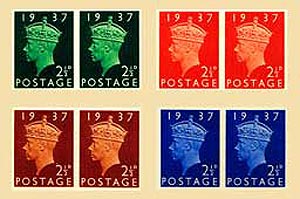
King Edward VIII was king for only 10 months, and never crowned. After becoming king in 1936, four definitive stamps were issued but they caused controversy in the design world because of their stark and innovative simplicity.
As a result, the typographer Eric Gill was asked to design another set of stamps to be issued at the time of the King's coronation. He based his designs on the Royal Mint’s medal showing the King crowned. Work continued on the design up to the final week of Edward’s reign but because he abdicated to marry Mrs Simpson, the stamps were never issued.
Extracted from British Postal Museum and Archive (BPMA)Courtesy: http://www.postalheritage.org.uk
The Machin Head

The current British definitive stamp (a stamp carrying the head of the reigning monarch, rather than a 'special' stamp) was designed by Arnold Machin and first issued in 1967.
When asked what it would ever take to replace the Machin Design, the Queen answered ‘A work of real quality’. Despite several secret efforts in the 1980s, no better image has yet been created. The Machin Design has graced British stamps and travelled the globe for nearly 40 years.
The stamp image was created from a photograph of a plaster cast sculpted by Arnold Machin RA. Machin's legacy is one of the most enduring and instantly recognisable icons of the 20th century. It is a striking design, simple and dignified, a timeless piece of work, which arguably has been reproduced more times than any other image in history - some 175 BILLION times to date, and rising.
Extracted from British Postal Museum and Archive (BPMA)
Courtesy: http://www.postalheritage.org.uk
Tuesday, January 24, 2006
Ukrainian: Overprinted Soviet Stamps
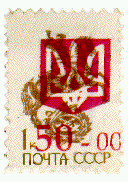
Interesting article published in the Ukrainian Stamps website:
Toward the end of the former Soviet Union, new postal rates were introduced. Most people in former Soviet countries used pre-stamped envelopes, so additional postage would be required to mail these old envelopes under the new rates. Authorities shipped large quantities of one- to five-kopeck stamps to post offices to add to pre-stamped covers. Later, when Ukraine declared independence, there were many such stamps in sheets in every post office.
Entrepreneurs in Ukraine realized that the overseas demand for their new nation's stamps could be tapped as a source of hard currency. Hoping to acquire the more stable foreign currency as a hedge against rising local inflation, they bought up most of the mint issues that the post office printed and advertised them for sale in the foreign press. Ukrainian postmasters tried to prevent shortages of these stamps by refusing to sell large quantities of them to the public. As a consequence, some issues such as the Easter, airmail, Cardinal Slipyj, and liberty were available only in half-sheets.
Above is an overprinted stamp from Lviv.
Despite this rationing, however, the first issues were quickly sold out and shortages continued. No stamps were available for local use, and postmasters were at their wit's end to serve their clientele. What were they to do? One answer presented itself.
Ingert Kuzych discusses the postal origin of modern trident overprint stamps in the English-language booklet "Ukrainian Postage Stamps - A Catalog of Issues from 1991-1995."
"In the spring of 1992, Ukraine Post ordered remainders of some low-value Soviet stamps of 1989 and 1991 (Scott Nos. 5838, 5839 and 5894) overprinted with trident-in-shield designs at the Borysfen print shop in Kyiv."
According to Kuzych, three major Ukrainian cities are known to have issued legitimate overprinted provisionals on Soviet stamps: Chernihiv, Kyiv and Lviv. However, Lobko's Catalog also includes the Zaporizhzhia oblast, particularly the city of Melitopol, as also having trident overprints on Soviet stamps. Overprints from Melitopol are somewhat difficult to describe, as they appear on a much wider variety of Soviet stamps. In addition, there are even variations in the appearance of the trident.
My first exposure to trident overprints was in about 1993, when I saw some mail sent to my parents from relatives in Lviv. I thought that it seemed an elegant political statement to take the Ukrainian national trident symbol or trizub and overstamp it on a Soviet stamp.
For full article and know more on Ukrainian philately, please access:
http://myweb.wvnet.edu/~roman/overprints/overprints.html
Ukrainian Orange Revolution Stamp

The world was gripped last winter by scenes of popular revolution in Ukraine, with orange-clad demonstrators pitched out in the snow fighting against the criminality of the old regime and for their democratic rights. The second round of the presidential elections in Ukraine in 2004 was conducted with the authorities guilty of shocking violations and systematic abuse of individual rights. Protesting under the slogans “Freedom cannot be stopped!”, “Together, we are many! We cannot be defeated!” hundreds of thousands people gathered on Kyiv’s Independence Square (Maidan Nezalezhnosti) on the evening of November 22 to stop the ruling elite from falsifying an election and hijacking Ukraine’s presidency. Over the next 17 days, through harsh cold and sleet, millions of Ukrainians staged nationwide nonviolent protests that came to be known as the “orange revolution”. They won.
On January 23, 2005, after a fair voting rerun, the opposition leader Viktor Yuschenko was inaugurated the President of Ukraine. To commemorate this event, a new Ukrainian postage stamp "Independence Square", showing people protesting on Maidan, was released on the Inauguration Day.
Technical Details:
Date of issue: 23rd January 2005
Designer: Photograoph by V. Pobedinsky, UNIAN
Paper: chalkyPrinting process: offset
Perforation: comb 11 1/2
Size of a stamp: 45 x 33 mm
Size of the Miniature Sheet: 106 x 170 mm
Miniature Sheet composition: 8 (2 x 4) - 7 stamps + label
Printing run: 500.024 (or 71.432 Miniature Sheets)
Face value: UAH 0,45
Color: Multicolor
More information: http://rememberrevolution.com/
Malaysia Stamps Issue for 2006
1. Wild Duck Species - 26.01.2006
2. 100th Anniversary of Jabatan Audit Negara - 14.02.2006
3. Rare Fruits Series III - 28.03.2006
4. Natural Scenery - Mountains of Malaysia - 26.04.2006
5. Fresh Water Fish - 25.05.2006
6. 50th Anniversary of Dewan Bahasa dan Pustaka - 22.06.2006
7. 50 Tahun FELDA 50 Years FELDA - 06.07. 2006
8. 2nd National Satellite RazakSat - 26.07. 2006
9. Malaysian Festivals - 15.08.2006
10. National Costumes of Various Races - 29.08.2006
11. Amphibians - 12.10.2006
12. XVIII FIGO World Congress of Gynecology and Obstetrics - 06.11.2006
13. Unique Marine Life - Stamp Week 2006 - 23.11.2006
14. 25th WVF Veterans World Conference - 07.12.2006
15. Joint Issue with Asean Country - Brunei - 21.12.2006
Saturday, January 14, 2006
China Year of Dog Stamp
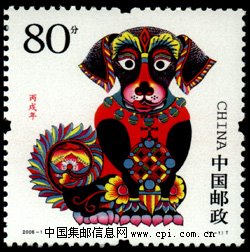
On 5 January 2006, China issued a one-piece set of special stamp entitled "Bing-Xu Year" with a face value of 80 fen.
The title of the picture on the stamp is "Bing-Xu Year".
The year 2006, according to the Chinese lunar calendar, is the Bing-Xu Year, or the Year of Dog. The dog is man's reliable companion through thick and thin together. As early as in the matriarchal society, primitive men living in the Yellow River valley began to raise dogs. With the development of civilization, dogs had been used to tend sheep and cattle. Dogs were not only kept as pets, but also deified by people. Legend has it that a dog, named Xiao Tian Quan, helped its owner God Erlang to subdue evil spirits, singing the praises of dog's loyalty and courage.
Courtesy: China National Philatelic Corporation
Friday, January 13, 2006
Malaysia Wild Duck Species
 Stamp Value :30 Sen ( 2 Designs ); 50 ( 2 Designs)
Sheet Content :20 Stamps
Paper :SPM,Watermarked, Phosphor Coated
Printing Process :Lithography
Printer :Percetakan Keselamatan Sdn Bhd
Stamp Designer :Reign Associates Sdn. Bhd
Date of Issue 26-Jan-2006
Thursday, January 12, 2006
Butterflies 2005
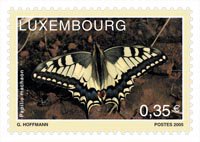
The swallowtail is among the most spectacular and largest of our butterflies. The wings of the female can reach more than 9 cm in size! It is in the tropics that one most frequently sees the Papilioninae sub-family. Mostly in springtime, the butterflies search for higher ground to carry out their famous «hilltopping», a type of nuptial flight that allows them to find a partner. The flamed variety is an even rarer species that populates northern Europe.
The silver-washed fritillary is a relatively common butterfly in Luxembourg. It is encountered in summer on sunny forest paths where it enjoys gypsywort. The males are a luminous orange colour while the females are darker with greenish colouration. The females eventually become entirely green. This variety is called the »valesina» variety.
The chalk-hill blue is among the varieties most frequently encountered. They are found in almost every country area, primarily on the dry limestone pastures. The males are known by their light whitish blue colouration while the females are brown with orange points on the lower edge of their back wings. In Luxembourg, it is the most recognisable argus butterfly.
Courtesy: Luxembourg Post
Christmas 2005
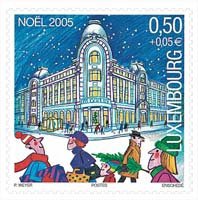 The end of the year is quickly approaching and, with it, the promise of pleasant evenings with family and friends. It is also a moment when excitement reigns, particularly in the streets of the town of Esch-sur-Alzette.
Parents shop with their arms loaded with gifts, while children are engaged in never-ending snowball fights close to the post office building.
The Esch-sur-Alzette post office building was built at the beginning of the 1930s from the plans of architect Nicolas Schmit-Noesen (1899 – 1964). Today, it houses a large counter area, local area mail workers, as well as the Esch "teleboutique".
Courtesy: Luxembourg Post
Silver Wedding Anniversary 2006

Subscribe to:
Posts (Atom)